


DAVOS, Switzerland, Jan. 26, 2026 /PRNewswire/ — UnionPay was recently invited to the World Economic Forum (WEF) Annual Meeting (known as Winter Davos) held in Switzerland. On January 21, Mr. Dong Junfeng, Chairman of UnionPay, spoke as a panelist in a thematic roundtable session titled “Chinese Economy: Fully Emerged?” During the discussion, Mr. Dong engaged with other panelists on key topics, including China’s economic development trends, innovation-driven growth, and China’s contribution to the global economy. The dialogue highlighted the strong resilience and the growth potential of China’s economy, and underscored UnionPay’s key role in supporting China’s domestic economic circulation, stimulating new quality productive forces, and promoting global economic cooperation.
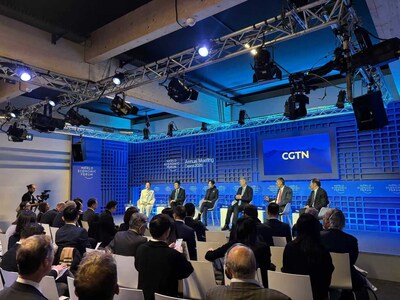
UnionPay innovates payment to facilitate consumption upgrade in China
Amidst mounting global economic risks and challenges, “resilience” remains a defining feature of China’s economy. In 2025, China’s GDP grew by 5% year-on-year to exceed CNY 140 trillion in total. Mr. Dong noted that China’s long-term stability and sustained growth stem from multiple positive factors, including the government’s long-term development planning and effective policy guidance, market players’ stronger vitality, consumption upgrade, and rising domestic demand, of which the final two are the most critical.
At the policy level, China continues to advance the new development paradigm in which domestic and international circulations reinforce each other. The 15th Five-Year Plan explicitly calls for special initiatives to boost consumption and expand the supply of premium consumer goods and services, providing a fundamental safeguard for sustained economic growth.
On the demand side, new consumption trends, business models, and use cases are emerging at a rapid pace. Data from UnionPay shows steady growth in the scale of digital payment in China’s consumer sector; new business models, such as live-streaming e-commerce, cross-border e-commerce, instant retail, and sharing economy, are rapidly gaining prominence; winter sports and tourism spending has surged by over 50%, while cross-border payment has grown steadily, with inbound spending up by over 60%. These trends indicate a shift in household consumption from traditional goods to diversified, high-quality, and intelligent use cases. The structural changes in the consumer spending is reshaping economic growth drivers, as consumption is driven by both goods and services rather than goods only. These changes have prompted the transition to light-weight and customized production and accelerated innovations in product supply.
In line with these trends, UnionPay leverages its strength in payment, and contributes to the expansion of the consumer market in volume and quality through technological innovation and service upgrading. The company has been building a payment network covering online and in-store use cases in both domestic and international markets, while optimizing payment experiences and lowering transaction costs. Such efforts have effectively unlocked spending potential, and provided strong support for enhanced commercial vitality, making UnionPay a key accelerator for China’s continued economic growth.
AI-enabled new quality productive forces: UnionPay is making active efforts to build an AI-powered ecosystem
Emerging fields such as artificial intelligence (AI) are becoming critical drivers of productivity gain and sustained economic growth. Mr. Dong observed that the global AI fever in recent years has witnessed breakthroughs in large language models, multimodal technologies, and intelligent agents, accelerating the wide adoption of AI. By improving efficiency, optimizing models, and transforming ecosystems, AI is unleashing new quality productive forces, and becoming a disruptive driver of economic growth, with the payment industry at the forefront of AI application.
In terms of efficiency improvement, AI contributes to lower costs and higher efficiency in personal productivity, corporate operations, industrial collaboration, and decision-making by automating repetitive tasks, optimizing decision-making processes, expanding production capacity, and eliminating workflow bottlenecks. In payment security, UnionPay has built an intelligent risk control system, where AI-assisted risk control rules constitute a solid line of defense for the safe and compliant development of digital payment. For service optimization, UnionPay launched the “Nihao China” app for international visitors to China, offering one-stop services through intelligent agents based on natural language interaction to meet personalized payment needs.
In model optimization, AI is turning industries from passively executing instructions to proactively responding to needs, giving rise to a range of new business models. As leading global payment companies venture into agentic payment, UnionPay takes the lead by launching the MCP Agentic Payment Service. This service not only integrates traditional payment capabilities, but also introduces an innovative agent-driven payment experience. Through conversations, users can seamlessly complete the entire process—from expressing needs to final payment. This model innovation makes payment easier and more customized, while integrating payment into the complete consumer journey, offering a new pathway for the digital upgrading of commercial ecosystems.
In ecosystem transformation, the advent of the intelligent commerce era is shifting businesses from “experience -driven” to “data- and intelligence-driven”. AI is enabling payments to go beyond their conventional role as mere settlement tools, and evolve into core infrastructure for the intelligent upgrading of economic activities. Building on the New Four-Party Model, UnionPay has been collaborating with industry stakeholders to explore and build an agentic payment ecosystem. Such endeavors are meant to provide a China solution for smart payment worldwide, and drive the growth of a payment industry that is more open, collaborative, and intelligent.
Deepening global cooperation for mutual benefit: UnionPay is connecting the world with the bridge of payment
In a world marked by heightened uncertainty in trade policies and geopolitical frictions, China remains committed to advancing high-level opening-up and offering opportunities to the world through its own development. As the “capillaries” of cross-border trade, investment, and people-to-people exchanges, payment has become a vital link for closer international cooperation. Mr. Dong emphasized that China’s sustained economic growth not only benefits the country itself, but also help forge stronger partnership in more markets worldwide. By fostering a development pattern featuring equal cooperation and mutual benefit, China is sharing the dividends of stable development and economic growth with the world.
To date, China is among the top three trading partners of over 150 countries and regions. The massive flows of goods and services to and from developed markets, including high-end manufacturing goods, financial services, medical care and pharmaceuticals have provided emerging markets with vast export opportunities and development prospects. This has driven local employment, industrial upgrading, and infrastructure improvement, enhancing self-sustained development capabilities.
Guided by the policy of high-level opening-up, UnionPay actively implements the international development strategy combining “going global” and “bringing in” by continuously improving its global payment network. For “going global”, a total of nearly 300 million UnionPay cards have been issued in 83 countries and regions outside China’s mainland. UnionPay’s acceptance network covers 183 countries and regions, including over 75 million international merchants. These achievements have laid the groundwork for an extensive and multi-level global payment network that provides stable and frictionless payment for two-way investment, trade, and people-to-people exchanges between China and the world. In response to the global trend of digital payment, UnionPay has been building an interconnected QR code payment network, and has been actively promoting the connectivity of digital infrastructure and specifications across different markets. This is to remove barriers in cross-border payment.
For “bringing in”, China has deepened institutional opening-up in the payment sector, with greater openness and broader international cooperation. The collaboration between UnionPay and major international card schemes such as American Express, Mastercard, and Visa in card issuance, acceptance, innovative payments, and infrastructure has made payment in China easier to better serve cross-border exchanges. Meanwhile, UnionPay is actively integrating domestic and international high-quality resources to build an open and collaborative ecosystem, exploring innovative cooperation models such as Network-to-Network (N2N) and Government-to-Government (G2G) partnerships with card schemes, clearing networks, and internet platforms. This is to accelerate the development of a new Four-Party Model for cross-border payment that delivers shared benefits and win-win outcomes.
As China’s edges in its immense market and established industrial system continue to stand out, UnionPay looks to the future with a commitment to serving the international market. Focusing on the high-quality development of the payment industry, it will continue to deepen technological innovation, accelerate the deep integration of new technologies such as AI with payment services, to continuously improve the quality and efficiency of serving the real economy. By promoting the interconnected and standardized development of the global payment market, UnionPay aims to deliver greater value to global partners, merchants, and cardholders, and to contribute even more to global economic cooperation and shared prosperity.
Photo – https://mma.prnewswire.com/media/2869476/image.jpg
 View original content:https://www.prnewswire.co.uk/news-releases/-unionpay-at-davos-2026-showcasing-chinas-economic-resilience-for-a-new-global-development-blueprint-302670124.html
 Disclaimer: The above press release comes to you under an arrangement with PR Newswire. TheNewsThisWeek.co.uk takes no editorial responsibility for the same.